
Understanding irony
Stephen Skalicky draws on language sciences, computation and psycholinguistics to understand how people use satire, irony, and humour.
Singer Alanis Morissette received a lot of flak after releasing her hit song Ironic in 1996, with many detractors saying the lyrics described situations that were merely bad luck, not ironic.
But it turns out, Alanis might have been right all along. Isn’t that ironic?
Dr Stephen Skalicky, who’s a senior lecturer in Te Herenga Waka’s School of Linguistics and Applied Language Studies, is a social scientist who’s interested in connecting the dots between language and the way our brains work. Using a combination of psycholinguistics, language sciences, computation and statistics, Stephen wants to understand how people create and interpret things like satire, irony, and humour.
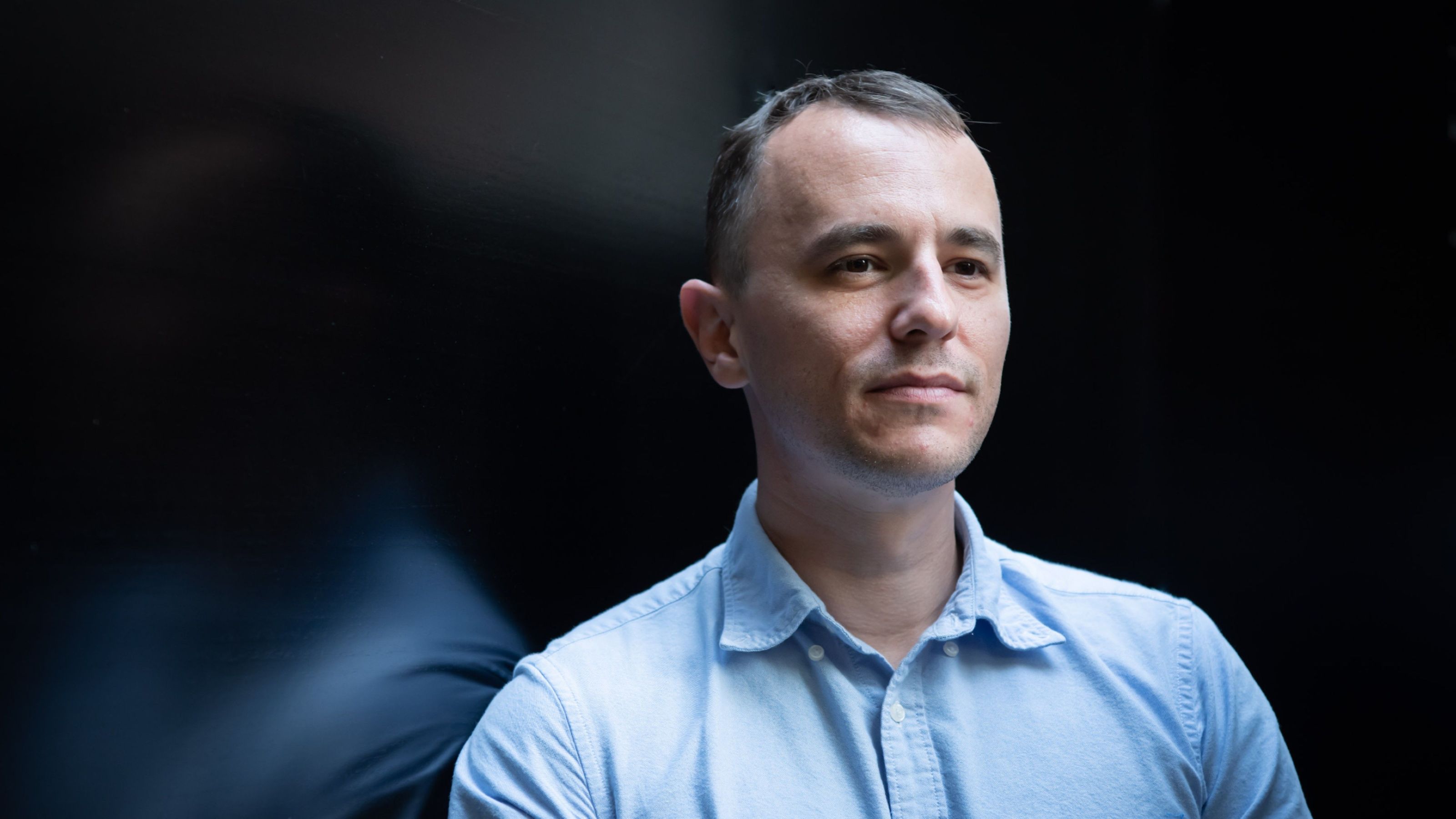
I’m interested in how people make sense of complex meanings. How do we know when someone is being sarcastic? Why do some people get sarcasm and some people don’t?
Dr Stephen Skalicky
Senior Lecturer
“That all comes under the broad umbrella of figurative language and humour studies, which is a huge, interdisciplinary field encompassing psychology, law, political science, media studies, and linguistics.”
Understanding the elusive nature of irony
Stephen’s latest research project, which has received a $360,000 grant from the Royal Society’s Marsden Fund, is aiming to uncover exactly what cognitive mechanisms lie behind irony.
“While there is a surface-level difference between verbal irony and situational irony, both originate from some form of ironic clash. For verbal irony, the clash is where what’s said and what is meant differs, depending on the context,” explains Stephen. “Situational irony is an unfortunate coincidence which violates one’s societal expectations—that’s the irony Alanis was singing about when she said ‘it’s like rain on your wedding day,’ or having ‘ten thousand spoons when all you need is a knife’. The reason the song was so controversial is because people have varying degrees of tolerance and expectations for these clashes. Moreover, people could all say something ironic in these situations.”
Stephen says understanding irony is crucial for human communication.
Irony requires us to grasp non-literal meaning embedded within social contexts. But an unanswered question in cognitive science is whether the irony in language or situations are of two different types, or whether they instead reflect an underlying proclivity to view the world through an ironic lens
Dr Stephen Skalicky
Senior Lecturer
Current theories suggest that a single cognitive mechanism—ironic contrast—underpins all forms of irony—Stephen wants to prove that by providing empirical evidence to back up that claim.
“For the Marsden-funded project I will gather a collection of verbal and situational ironies, measure how people respond to these ironies, and then use multimodal—text and image—artificial intelligence models to create a computational representation of ironic contrast,” Stephen says.
“The AI component addresses what continues to be a limitation with large language models, which can often miss subtle, non-literal meanings that humans grasp intuitively. The results of my study will provide the first computational model of irony, which will be useful both for cognitive science research, and to help the artificial intelligence industry create AI models that are better at detecting and explain irony.”
Stephen’s study will be the first systematic, empirical comparison of human processing data for verbal and situational irony and will provide unprecedented insights into the fundamental nature of irony. Depending on the findings, the study could confirm theories of a single cognitive mechanism underpinning all forms of irony, or it could suggest that irony is uniquely constrained by language or situation.
“I’m very interested in the cognition of irony, and I’m also fascinated by the AI space—currently, language models can be fed a bunch of [satirical news website] Onion articles, and can become good at making things that look like Onion articles. But that doesn’t mean the AI knows what satire actually is. Hopefully my research will be able to take those AI models to the next level.”
The power of interdisciplinarity in research
Working in an interdisciplinary way is very important to Stephen.
“Siloing in academia is not good—in my research, I try to understand things from a range of perspectives” he says. “I teach psycholinguistics, which looks at theories of how people learn language and how language is represented in the brain. I lecture in the Language Sciences programme, I teach into the cognitive science programme within the School of Psychological Sciences on my research into cognitive linguistics, and also teach a Python computer programming course on computational lingustics.”

He also recently published research that analysed satire in the law.
Stephen says language is a lot more complex than prevailing linguistic theories might suggest.
“For hundreds of years, people have assumed that we’ve memorised language as a set of rules and patterns. But I think things like humour and irony have always challenged that,” he says. “Take, for example, the phrase ‘thank you’—if I say ‘thank you’ after you hold a door open for me, versus if I say ‘thank you’ after you slam the door in my face, those are two very different meanings. That inferential process shows that language is far more complex than we give it credit for, sometimes—humour and satire give it that depth.”
Find out more about research in Te Kura Tātari Reo—School of Linguistics and Applied Language Studies.